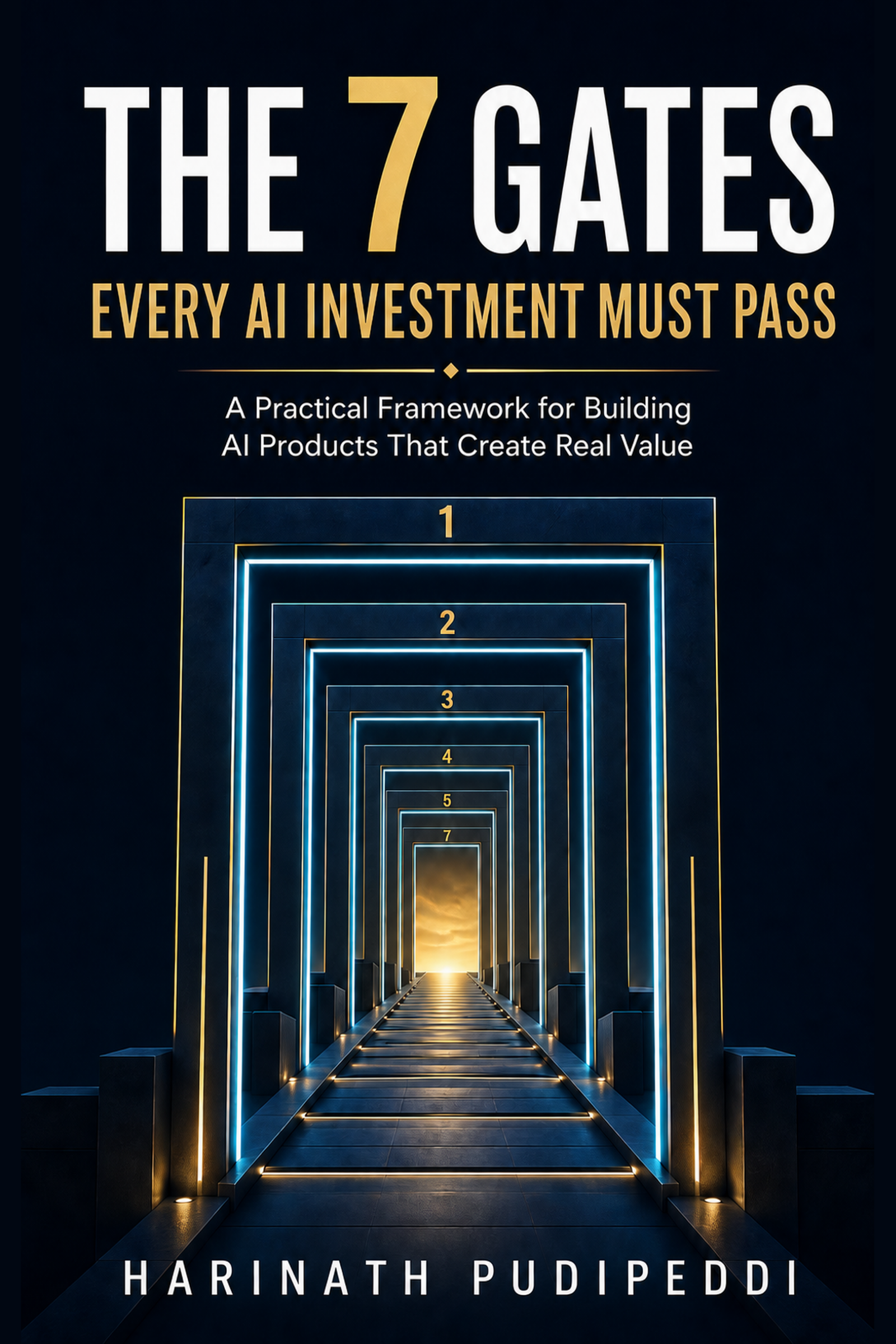
The 7 Gates Every AI Investment Must Pass
A practical framework for building AI products that create real value.
Most AI products don’t fail at the model.They fail at a question nobody asked first — a decision locked in before a line of code, and only revealed once it’s expensive to fix. Seven gates catch it while it’s still cheap.
They don’t fail at the model. They fail at a question nobody asked first.
A team finds a use case, says “let’s add AI,” and sprints to build. Months later it technically works — and nobody uses it. Or it loses money on every interaction. Or a competitor copies it in a quarter.
None of those are engineering failures. They are decision failures — the kind locked in before a single line of code, and only revealed once they’re expensive to fix.
The seven gates catch them early, while they’re still cheap to change.
Adding AI has never been easier. Building the wrong AI hasn’t either.
- 01
Any team can bolt AI onto a roadmap in a sprint. That ease is exactly why so much of it creates no value.
- 02
Most AI failures are decided long before a model is trained — in the questions nobody stopped to ask.
- 03
A demo that wins the room can still lose money on every single interaction at scale.
- 04
What looks like a moat today is copied across the category in a quarter.
- 05
Teams rush to build before anyone checks whether AI was ever the right tool for the job.
None of these are engineering problems. They are decision problems — and decisions are cheapest to fix before you build.
Seven gates. One test. Before you build.
The Liquid Ocean® AI Value System is a seven-gate test every AI idea must pass before you build it — not after. Each gate is a question most teams skip. Skipping one is where the expensive failures hide.
Customer Problem
AI can’t fix a problem you haven’t proven is real. Start with the pain, not the technology.
- → What problem are we solving?
- → How often, and how painful?
- → What does the customer do today?
AI Necessity
The most expensive AI is the AI you didn’t need. Make it earn the complexity.
- → Why AI, specifically?
- → Could rules or workflows solve it?
- → Does AI materially improve the outcome?
AI Role & User Outcome
Assisting, recommending, and deciding are three different products. Choose on purpose.
- → Assist, recommend, or decide?
- → What’s the expected user outcome?
- → How will success be measured?
Trust & Failure
Your AI will be wrong. The question is what happens next.
- → What if the AI is wrong?
- → Can the output be verified?
- → Is it reversible or auditable?
Technical Readiness
A great idea dies on missing data. Confirm the foundation before the feature.
- → Is the data available, reliable, permitted?
- → Is fine-tuning required?
- → Is there a fallback?
Economics & Viability
A demo impresses once. Unit economics decide whether it survives at volume.
- → Is there a revenue loop, or just a sale?
- → What’s the cost per interaction?
- → Is there clear willingness to pay?
Learning & Advantage
If a competitor can copy it in a quarter, it was a feature — not an advantage.
- → Does usage create proprietary data?
- → Does it get better over time?
- → Is it hard for competitors to replicate?
Pass all seven — move forward. Fail one — revise.
The seven are gates, not a scorecard. A single unanswered gate is enough to send a promising idea back to the drawing board — while it’s still cheap to change.
Why gates — and why before.
Ask why an AI product failed and most teams point at the model — it wasn’t accurate enough, the data was messy, the tooling wasn’t ready. Those are real, but they’re rarely the reason. The reason is almost always a decision made much earlier, when the idea was still a sentence in a planning doc: a problem that wasn’t painful enough, a role for the AI nobody chose on purpose, an economics no one ran.
A scorecard averages. It lets a strong score on six factors quietly cover for a fatal weakness on the seventh. AI doesn’t work that way — brilliant economics can’t save a product no one needs, and a real customer problem can’t survive data you’re not permitted to use. So the seven are gates, not weights: each one has to open on its own.
And gates sit before you build for one reason — cost. A wrong answer caught in a planning session costs a conversation. The same wrong answer caught after launch costs a quarter, a budget, and often the team’s credibility. Gates don’t add discipline for its own sake; they move the expensive questions to the one moment they’re still cheap.
The 7 Gates are the Liquid Ocean® framework brought to a single decision: whether to build an AI product at all. The same beliefs run underneath — customer value before technology, value exchange over feature counts, advantage that has to be renewed because it always erodes. Liquid Ocean asks how organizations stay relevant over time. The 7 Gates ask the same question at the moment of investment, before a line of code commits you to the answer.
The right question, asked early, is cheaper than the best model, built late.
Harinath PudipeddiThe 7 Gates Every AI Investment Must Pass
For everyone who decides where AI goes.

Harinath Pudipeddi
Harinath Pudipeddi is the creator of Liquid Ocean®, author of The Liquid Ocean Compass and The 7 Gates Every AI Investment Must Pass, and Founding Principal of Studio NAVAKA.
Across more than two decades, Hari has worked as a technologist, product strategist, business leader, entrepreneur, executive advisor, and educator. His experience spans technology, healthcare, real estate, product strategy, innovation, international market development, and organizational leadership.
Through Studio NAVAKA, he works with organizations, founders, and leadership teams to move from ideas and existing advantage toward strategy, customer relevance, revenue design, and continuous reinvention.
Liquid Ocean® is his proprietary framework for leaders and organizations that must continuously reinvent in a world shaped by AI, automation, changing business models, and shifting customer expectations.
Before you invest in AI, pressure-test the decision.
The framework becomes capability when your team runs its own ideas through the gates — with the questions asked out loud, in the room.
AI Value System Assessment
Run your AI initiatives through all seven gates and get a ranked view of what’s ready, what’s risky, and what to stop.
Explore the Assessment →The 7 Gates Workshop
A live session walking your product, engineering, and commercial leaders through the gates on your own real AI ideas.
Explore the Workshop →Executive Conversation
Invite Hari to speak with your leadership about building AI that creates real value — not just AI that demos well.
Invite Hari →The best model, built late, still fails.
Run your AI idea through the seven gates before it becomes a roadmap — while changing your mind is still cheap.